Having written two historical suspense novels, I thought it was time to pause and look into writing courses that would help me hone my craft. I’m signed up to Imogen Hermes Gowar’s Writing the Past course which starts this month, and in preparation, I’ve started to research and plan my next novel.
I’m going to be editing my next gothic thriller for Hodder over the next few months, which is going to take up most of my time and attention, but last year, I did write a rough outline of an idea and sent it to my agent to see if it had legs. This is the outline I’m going to take to the writing course in March. For my first two historical suspense novels, I confess that I didn’t lean too heavily into research. All of my books are very much character-led, and my Victoria Hawthorne novels are no different, but I really want to delve deeper into this next novel, and for very good reason: it’s going to be set in my house.
Now
In December 2021, I moved to a small village in Aberdeenshire, Scotland. Located over 600 miles away from our tiny Hertfordshire house, my wife and I fell in love with this gorgeous Victorian property, full of character and history and with more space than we know what to do with. The previous owner left us a book full of old photographs and information about the village and this house, and I knew I would soon dive into the rich history of our new home.
I’m going to start with a few experiences we had in the house, and the reason will become clear as I share what I have discovered since. First, when we were decorating for Christmas the year we moved in (a rush job, with most of our contents still in boxes!), I told my wife that I felt like there is music here. A few months later, when we were walking the dogs along the river that runs beyond the house, she turned to me and asked what I would do if she said she saw a figure standing at our bedroom window. A seed of an idea was planted, then (after a hasty glance upwards!), which I tucked away to germinate while I worked on other books. Finally, the name Beatrice came to me and was included in the outline I sent to my agent late last year for the character from the past. Character names change all the time, but often, the names I choose will mean something to me, and that is very much the case with Beatrice.
Then
The first thing we discovered was that this house once belonged to the Congregational Church, which no longer exists in our village. Actually, the first thing we discovered is that nobody seems to know much about the history of this house. There are several manses in the village, owing to the multiple churches within walking distance, but this manse in particular seems to have been lost to the passage of time.
Much of this village was owned by the Leith-Hays, who resided in Leith Hall from 1650 until just after the Second World War. Colonel Alexander Sebastian Leith-Hay is mentioned in the title deeds we were given when we purchased this property, and it seems he set out the burdens attached to it. I then retrieved a title deed from the Land Registry Service which states: ‘40 perches of ground, with buildings &c, thereon forming [the property]. described in Feu. Ch. to Trustees of Congregational Church… recorded 23rd March 1885′. Another document states: ‘piece of ground (40 perches) on which a Manse or Dwelling House and other premises for the Minister of said congregation have been built‘.
This house (or manse), therefore, had been built prior to 1885, as accommodation for the minister and his family, but built by who is still a mystery. The Leith-Hays owned much of the village at that time, so perhaps they simply leased the land to the church prior to selling (or gifting) it in 1885.
The property was known by several names over the years (which is quite infuriating when trying to find census records!), including the Congregational (sometimes misspelled at ‘Congreational’) Manse, the Conge Manse, and other more modern names, which I won’t share in the spirit of retaining some level of privacy.
The first census record I found was from 1881, when Thomas Haver (later Havre) was the minister and lived in the property with his wife, Jane Hay Byers, and at least one child. Another website says he was the minister here since 1879 (which, coincidentally, is also the year the manse was purportedly built, according to some documents in the local museum), and also states that by 1883, he had moved to Lanarkshire, which is evidenced by the 1891 census record. It is currently unclear whether someone else was resident here between 1883 and 1891. In 1891, James Edwards was the resident minister, living here with his family, and he also moved to Lanarkshire for the 1901 census, though the exact date of his move is also unclear. One of the things that stood out from his census records was his daughter: Beatrice Edwards, age 6.
After this revelation, I hit a dead end, and it was at this point that I had to engage the help of the customer service team at Find My Past (shout out to Joanna). Together we managed to find the 1901 entry for the property (again, under a different name), where Williamina Williamson (poor woman) is named as the head of the household. Being 1901, a married woman was unlikely to actually be the ‘head’ of a household, and further inspection revealed that her occupation, so to speak, was ‘clergyman’s wife’. After some more digging, I found her husband, Laurence Williamson, who was the minister at the time, had been with his mother-in-law in Aberdeen when the census was taken. Mystery solved. One of the Williamson children also stood out, only this time it wasn’t their name, but their occupation. Elizabeth Williamson, aged 21, teacher of music.
So, we have Beatrice and we have music. A coincidence, some might say, but a rather spooky one.
Now again
At the time of writing, I’ve hit another dead end. Census records for Scotland after 1901 are not available through Find My Past, so I now need to go to Scotland’s People and try to find my way through their records, or rely upon the generosity of their service team. As mentioned, I have visited the local museum, where the lovely Henrike found an old photograph of the house. Accompanied by no information, it is also undated, but the eagle-eyed Kathryn from Tea Leaves and Reads pointed out that there is no TV aerial on the roof. Google tells me that television first became available in Scotland in 1952, and this house was privately owned at that point, having been sold to the sitting tenant, a bank manager, in 1948. Any thoughts or suggestions about the age of the photo would be very much appreciated.
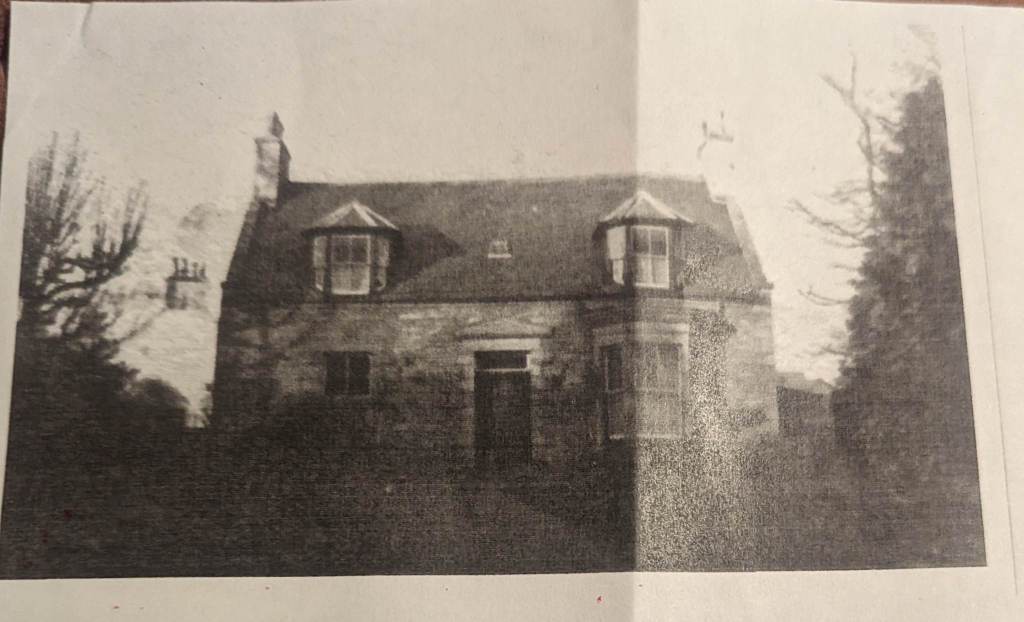
I have also reached out to the reverend of the local parish church, in the hope she will educate me on the history of the church in Scotland and, hopefully, shed some light on the people who once lived here. I’ll write another blog post once I have more information, if only to have all of the information in one place.
One thing I did discover is that the Scottish College (Congregational and United Reformed) produced its first female minister in 1926, Vera Finlay. To my knowledge, she never lived in my house or anywhere nearby, but I have filed that tidbit away for the writing course.
But what is the book idea? I hear nobody ask, but I will answer it anyway, albeit in a vague, insufferable way. It is another timeslip novel, with a character in the present day, Esme, and a character in the 1920s, Beatrice. One night, the two women swap places, finding themselves in each other’s time period, communicating through a mirror. They have to find a way to navigate through the other’s time period, while trying to get back to their own. (Side note: Anyone who has read any of my novels and hated how many queer characters there are will want to give this one a miss.)
Vera Finlay is interesting because I wanted my character, Beatrice, to be someone important to her time, which is why she must return to it. The first female minister in charge of a church in Scotland seems like a rather important role, especially given the history of this house, don’t you think?
 VIKKI PATIS
Leave a Reply